“The children are always ours, every single one of them, all over the globe; and I am beginning to suspect that whoever is incapable of recognizing this may be incapable of morality.” -James Baldwin
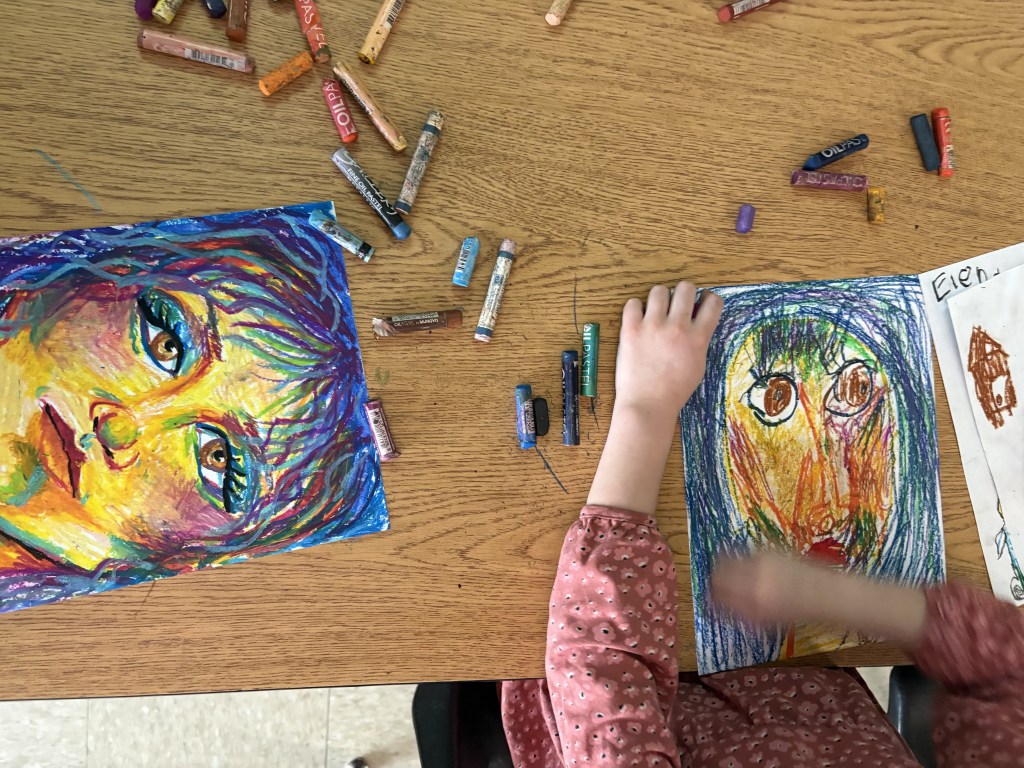
Working in arts education is one of the many great privileges of my life. Despite any tiredness I may feel after a day of doing art with varying groups of children, or however many kids pick their noses before hugging me, or yell: Miss, he stole my markers! I still view it as a very special experience that I get to have. Every week, I work with a team of artists to prepare supplies to deliver art programming to the children in my region. It’s a beautiful, simple, and meaningful work practice that allows me to give back to my community through giving children the tools to create and express themselves. Through my work in arts education, I have noticed that society seemingly cannot help but devalue children. You may read this and feel something stir within you, a voice that says I love children, I would never devalue them, but please allow me to explain.
In Northern Italy there is a small town called Reggio Emilia. The town of Reggio Emilia runs their schools very differently from ours in North America, so let me tell you about it. In Reggio Emilia, the focus is not on children learning so that they may demonstrate to adults what they learned and how, but rather, the focus of learning is geared towards giving children a space where their knowledge, exploration, and creativity can be explored on their own terms. In the town of Reggio Emilia, children are viewed as competent learners, and the environment they exist in is seen as the “third teacher.” The goal is to have children learn through experiments, curiosity, and play. But how did this come to be?
After World War 2, a man named Loris Malaguzzi and some local parents created a project called the hundred languages of children, suggesting that children express themselves in many different ways, and that we as adults must shift our ways of seeing to accommodate the many ways children can teach us, rather than us teaching them. Thus the Reggio Emilia pedagogy was born, a philosophy of learning that focuses on children leading themselves to learn through their own curiosity. As you might imagine, through this pedagogy, the children of Reggio Emilia began to create art that posed many questions about the world, and also, gave many answers. The children had so much within them that they didn’t need a strict curriculum based on input and output, all they needed was for adults to facilitate spaces where they were allowed to explore that which they already knew, and that which they could discover through exploration.
Now that you’ve heard about Reggio Emilia, I’m sure you are drawing comparisons between your own experiences being a child at school. I can imagine that less children would dread going to school if it were a place of exploration, play, and curiosity, but here in the west, school is about productivity and production. Can you learn all of this, memorize it, and tell it back to me? Can you look at this picture and draw it in the correct perspective? Can you kick the ball into the net? By setting up education to be a system of input and output with no room for exploration, we tell children that their ideas do not matter. We devalue children and treat them as things to be moulded, rather than entire human beings who have lots of knowledge of their own.
A few weeks ago, Canada was being ravaged by wildfire smoke. In certain places, it still is. Entire towns burned, forests gone, people evacuated from their homes. What does this have to do with kids? It has everything to do with them.
This week, the group of artists I work with was presenting an activity based on Scent. We have been working on the theme of the five senses and encouraging children to create art based on their sensory experiences. So the week that Canada was enveloped in smoke, there we were, asking children, What do you smell? What does it make you think of? How can you represent that? As I’m sure you’ve guessed, they all said they smelled smoke. They drew tiny forest fires, made stickers with symbols of burning fire, and drew clouds of smoke covering their cities. If you’ve never witnessed it before, a child telling you that all they smell is smoke, while you’re squarely aware that your government is cutting climate resources, is heartbreaking. It signals to me a deep need for us to embrace an open model of experiential learning, like they have in Northern Italy. But why?
Children are our future. They are the earth’s future. When we shuffle children into schools and tell them to successfully complete questionnaires and tests without asking them, What do you notice? How does it make you feel? We rob children of the autonomy to tell us what they already know: the earth can only go on if people care enough to help it. The earth needs us to be its stewards. And yes of course, the children don’t need to focus on the horrors of climate change all of the time, but they notice more than you think. Children are incredibly intelligent, observant, creative, and willing to learn if we will only let them be teachers too.
That week we discussed scent, all of my coworkers said that the children they worked with talked about the wildfire smoke. Some children knew why there was smoke, some children didn’t. Some children noted that they felt bad for the animals, who had nowhere to go when their homes were on fire, and worse, because the animals did not know why their homes were on fire. But children are people of their own, and they do know why the land is burning, in their own ways. Their hearts ache for the people and animals displaced, for the nature that will have to fight to grow back; and it is our duty to trust that children know more than we assume. They can understand more than we think, if we only respect them enough to allow them the opportunity.
If you are a parent, or a caregiver to a child, I hope that next time your child brings home a bad mark on a test, or isn’t listening in class, you afford that child the space and respect to ask them why. They feel and know so much, and are only waiting for an adult to genuinely care. Even if you are not a parent, caregiver, or educator to children, I hope you can read this and understand that there are small ways we can be there for all children by giving them space to be expressive and curious.
I hope you can go forward after reading this and see children as full human beings, not something to be influenced and shaped into what you think they should be. Next time you complain about a child crying on a plane, or a child not minding their personal space in a store, or any grievance you may have with the children of our society, please consider that they are expressing themselves in the ways they know how. They are much smarter than we give them credit for. So please, think of the children. Give them your care and love freely, without any hope that they will act in the way you believe they should, because they are people, and they need to be cared for. Not just the children in your community, but every child, all across the world. They all deserve this grace and care, and hopefully, if we can take anything away from the people of Reggio Emilia with success; we can someday create a world in which children are not just controlled and shaped, but seen and appreciated for all that they are.
Let us go forward and share the duty to uplift children near and far. To remember that we all once stood in the shoes of a child, confused, scared, and hopeful that the world would embrace us. We can be that embrace, we can embody that hope, and we must do everything in our power to reject defeatist narratives that tell us we are bound to leave a burning world to the children of tomorrow. We must push back on the cutting of climate resources, we must protest the colonial notion that the land is meant to be used for resources and capitalist gain, because we must think of the children. Children are everything we have, and beyond that, children matter simply because they are; and it is our duty to create a world where they can be loved and encouraged, not for what they learn, not for what they do, but because children are whole already, with or without us.

Leave a comment