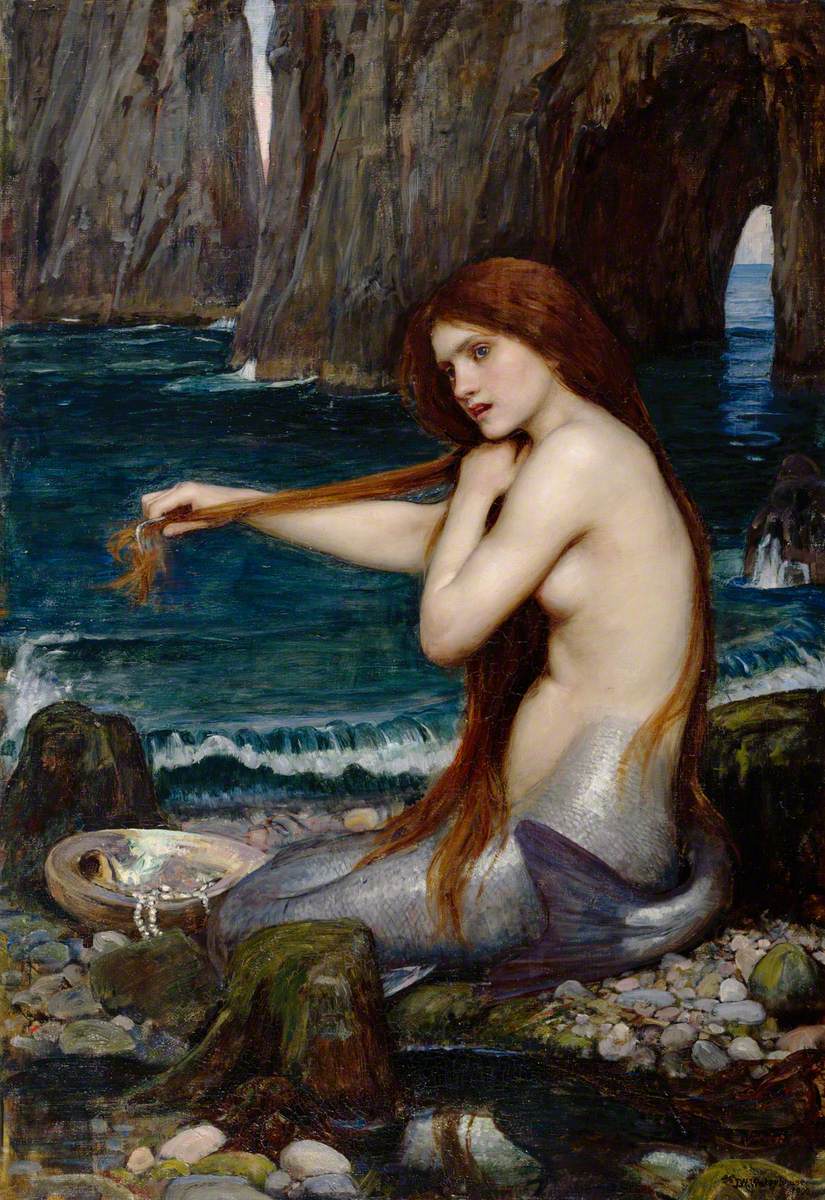
“But a mermaid has no tears and therefore she suffers so much more.”
-Hans Christien Andersen
For as long as I can remember, I have been utterly fascinated by the esoteric nature of mermaids. Be it too many viewings of my old VHS of Disney’s The Little Mermaid as a young girl, my childhood obsession with Aquamarine, H20: Just Add Water, and Barbie Fairytopia Mermaidia, or just a general fascination and love for the ocean, my brain has been permeated by merfolk forever. After all, is the purpose of the siren not to enchant us? Yes. But why have these creatures of the deep been a fixation of human myth for so many years?
To understand, one must look to the dense history of mermaids and the folklore that surrounds them. Whether or not you believe in merfolk, they have an undeniably rich history of myth and legend that spans far earlier than the European colonists who claimed to see them on journeys across the Atlantic. Today I am looking at ten different mermaid legends, and attempting to understand what they can tell us about humans.
The History of The Mermaid
Earliest documentation of mermaid-like creatures goes as far back as 1000 BC, in mesopotamian legends from Assyria (modern day Syria). The Assyrian Goddess of the moon, feminine powers, and water, named Atargatis is often called the first mermaid. The story goes that Atargatis fell in love, and after being accidentally responsible for the death of her lover she could not live with the guilt; leading her to drown herself in a lake, and turning her into a mermaid. This is the first of many tragic mermaid tales to come.
Mermaids are present in all cultural folktales. The ancient Greeks had sirens, which began as birdlike women but developed to be fishtailed women as time went on. Homer’s Odyssey is an early text that represents Greek sirens, though they are depicted as bird woman sirens their power is still that of crashing ships with their song. “First you will come to the Sirens who enchant all who come near them. If any one unwarily draws in too close and hears the singing of the Sirens, his wife and children will never welcome him home again, for they sit in a green field and warble him to death with the sweetness of their song.” This early representation of sirens as fearsome and dangerous certainly stuck, as this is how they are often depicted throughout much of history.
Moving North and East, the Slavic people have the Russalka; a fish woman of the sea that seduces men to their deaths. There are many variations of this legend throughout history. In early pagan practices the half lady half fish Russalka was a symbol of fertility and came out of the water in spring to bring life back to the earth. Later in the 1800’s they became known as spirits of young women who had died by drowning or suicide.
The mermaids of Africa are Mami Wata, water spirits and goddesses seen as devious women who lure men to their deaths. The tales of Mami Wata are also popular in the African diaspora in the Caribbean and South America.
In Chinese folklore there is a race of merfolk called the Di people, said to inhabit their own nation and kingdom. Though so far we have seen distinctly gendered female mermaids, this is an example of gender neutral merfolk. These creatures were seen as closer to gods, as Di in Chinese is translated as “God” or “Highest emperor”.
In Korea, a land surrounded by sea on three sides, there are many tales of mermaids that come from seaside towns. A popular Korean mermaid story comes from Dongbaek Island of Busan, the tale of Princess Hwang-ok; a magical mermaid who comes from an undersea kingdom called Naranda. This tale of the mermaid princess is allegedly inspired by a historic Indian queen; a great example of how mermaid mythology represents cultures influencing one another.
Off the coast of Scotland in the Orkney Islands there are tales of the finfolk. These creatures are sea dwelling shape shifters who steal people from the shores or sailors from their boats. In these legends, male and female sirens are differentiated by the terms “Finman” and “Finwife”.
The Passamaquoddy Tribe is an Indigenous tribe that originates from the land known popularly as the space between Maine U.S.A and New Brunswick Canada. The Passamaquody legend of He Nwas is a story of two young girls who tow a canoe into the water instead of obeying their mother and staying by the shore. As a consequence for being in the water when they shouldn’t have been, the girls turn into mermaids.
In South America there is the story of the Iara, which originated in Brazil from Tupi mythology. A mermaid of the amazon river, she is known to be very beautiful and is a seductress of the water who draws men to their deaths.
In French folklore, there is a famous mermaid named Melusine; a female water spirit found in freshwater or wells who has a serpent’s tail. This was a popular legend in France, and around its time of popularity in 1566, the Swiss philosopher Paracelsus created a treatise called ‘A Book on Nymphs, Sylphs, Pygmies, and Salamanders, and on the Other Spirits’. This documents his theories about there being spirits on our earth that correspond to the four elements. In describing water spirits and mermaids, he coined the term ‘Undine’ which later became a popular name for mermaids in the region. Inspired by this, the French baron Friedrich de la Motte Fouqué released a novella called ‘Undine’ about a water spirit woman who marries a human man to gain a soul. This novella was a major inspiration for Hans Christian Andersen when writing his famous work ‘The Little Mermaid’ . On the topic of his own depiction of mermaids, Andersen writes “I have not, like de la Motte Fouqué in Undine, allowed the mermaid’s acquiring of an immortal soul to depend upon an alien creature, upon the love of a human being. I’m sure that’s wrong! It would depend rather much on chance, wouldn’t it? I won’t accept that sort of thing in this world. I have permitted my mermaid to follow a more natural, more divine path.” I believe this work the first popular novel that truly humanizes the mermaid; and sets the stage for our current view on them.
Our Fascination With Mermaids Explained
Mermaids are ever present in our stories, almost as if we need them to remind ourselves of the ocean’s power, danger, beauty, and mystery. As mere mortals, we love to wonder about godlike creatures and monsters beyond our realms; though it seems ancient people believed monsters could be as close as in the local town river. When investigating historic myths and legends, it seems the answer to our fascination with mermaids is clear. It comes down to one question: what if something could be as beautiful as it is dangerous? What if something could be so captivating, alive, entrancing; but also deadly? The ocean is, and so are mermaids. They have long been used for warnings, a way to keep your kids away from the water or encourage cautious sailing; but our modern day view of the mermaid has changed from the ancient tales that villainize these strange and feminine creatures.
Looking at Disney’s film adaptation of Hans Christian Andersen’s novel, The Little Mermaid (1989), the Disney channel original movie Aquamarine (2006), and the Australian TV show H20 Just Add Water (2006), there is one common thread that runs through these popular modern mermaid stories. Ariel collects human trinkets and wishes to see the above world and meet the Prince, Aquamarine makes friends and wishes to fall in love, and Cleo, Rikki, and Emma all wish to lead normal teenage lives. Why do these feel so different from the old tales? Where is all the death and deceit of these evil creatures; where is the warning? It seems in the hundreds of years between now and then, we have decided that the monster is deeply worth humanizing.
Instead of fearing the strange fish ladies, we have decided to relate to them. We have chosen to get to know them, to understand their desires and their fears; and even to love them. In tales of old, humans have fixated on the part of mermaids that makes them monstrous, but now our focus lies in what makes them human. They are sinister creatures born of the ocean, yet curious humans; bound to be othered forever. How could we not be fascinated by what exists on the line between the monsters we fear most, and our truest selves?


Leave a reply to amphisbaenacolorfulf22d54d51c Cancel reply