Where there is a sea there are pirates.
-Greek proverb
Why Pirates?
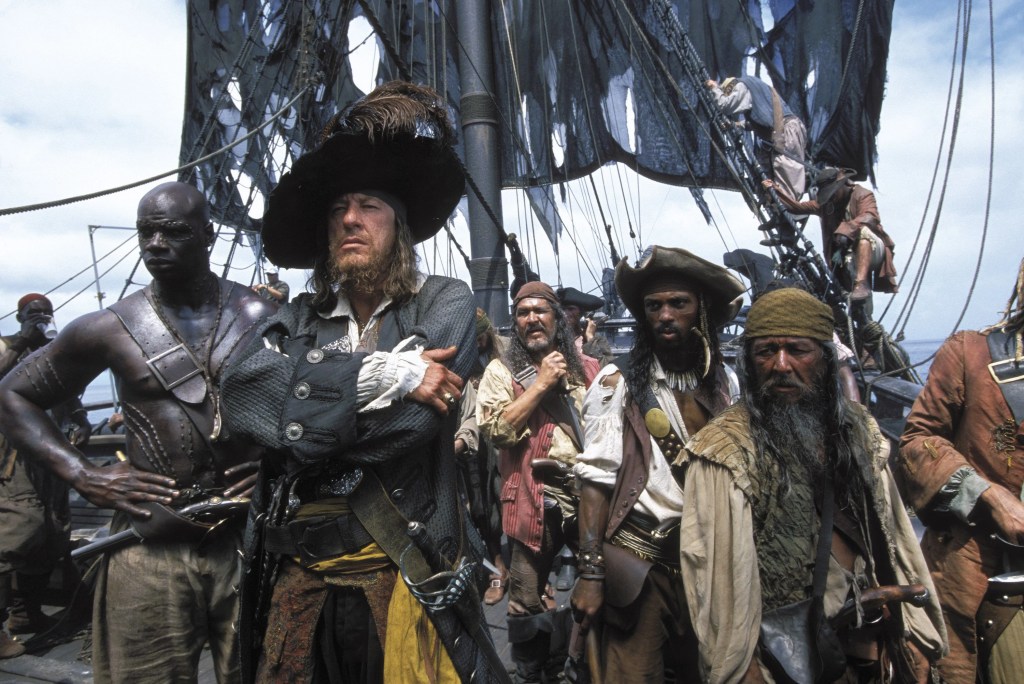
For much of history, tales of the sea have included our favourite mischievous and mysterious sailors; pirates. Pirates are bold, daring, fearsome, yet continuously alluring to us. My first pirate tale was Disney’s adaptation of J.M. Barrie’s Peter Pan, which enthralled little me as it swept me into a world of fairies and mermaids and pirates. Naturally as I grew older, Pirates of The Caribbean became my next fixation. From movies like Hook, to the Muppets Treasure Island, to Sinbad: Legend of the Seven Seas, I was absolutely enchanted by pirates. But why? We are expected to inherently disagree with the act of piracy, so why is our world full of stories that lead us to empathize with and grow to love these nautical thieves? To understand, we must look to the past.
Early Pirates
The history of piracy goes back to the bronze age, when a group called the Sea Peoples began to pillage Mediterranean ships along the trade routes around the Aegean sea.

It is highly disputed where the Sea Peoples originate from, and it is assumed that they come from many places around the routes they sailed. The Sea Peoples invaded Eastern Anatolia, Syria, Palestine, Cyprus, and Egypt; causing so much trouble that the Egyptians waged war against them not once, but twice!
Pharaoh Ramesses the third waged the final war against the Sea Peoples, ending their reign on the Aegean once and for all. They fought along the border of Egypt and Syria, and when Ramesses and his men had defeated them there, he coaxed their ships into the Nile River, then defeated the Sea Peoples there as well. A meager few groups of them were left, and settled in many of the lands they had originally invaded around the Aegean; renouncing their lives as pirates.
Piracy continued to become popular in this area of the world, as the Mediterranean sea connects to so many different lands, piracy was easier to get away with more frequently; hence the Greek proverb that begins this article (Where there is a sea there are pirates). The Phoenicians, Illyrians, and Tyrrhenians were all known as pirates at this time; though in the pre classical era, piracy was known as a viable career. The Greeks especially had a respect for piracy that would be lost as history spun on. During the 1st century BC, there were pirate states that had popped up along the Anatolian coast. The pirate states posed threat to the commerce of the Roman Empire; and on one journey across the Aegean, Julius Caesar was even captured by Sicillian pirates who held him on a small Greek Island.
In the early 5th century, there lies another historically notable tale of pirate capture. Saint Patrick (Yes, the actual saint.) was allegedly taken and enslaved by Irish pirates who brought him to Ireland, where he apparently worked for six years herding sheep. Though he was originally likely from Wales, Patrick noted this experience as an inspiration for him to become a missionary and return to Ireland to spread the word of God. Many historians negate the possibility that this really happened, and believe it was a fabrication made by Patrick himself, created to control his he would be viewed and remembered. True or not, it shows us the prominence of pirates and how they were deeply feared in these times.
Pirates of All Around The Word
There are many groups of pirates that have been known through different times in history that come from all over the world. As early as the 8th century there were groups of Slavic pirates in the waters of the Baltic coast. Many confuse them with Vikings, but there were many groups of pirates in the Baltic region at this time that were a part of their own groups that had nothing to do with Nordic Vikings.
Of course in the early middle ages there were the notorious Vikings, the feared Nordic pirates. They travelled to and raided many places on the coast of Western Europe as well as North Africa and Italy.

In the early middle ages there were Arab pirates raiding the Adriatic coast, Slavic pirates invading Roman territory, the Irish pirates joining up with the Welsh and Scottish pirates as well as the Vikings and Picts to invade England; from the year 800 on, piracy becomes increasingly common. Piracy continues growing in popularity and risk at this time; as it will eventually become a crime punishable by death in many places.
In the year 1241, under the reign of King Henry the third of England, a man named William Maurice was accused of piracy; and therefore hanged, drawn, and quartered. It is written that he was the first person to receive this sentence for the alleged crime of piracy. Piracy was a severe crime in England, and by this time it was a profession many looked down upon.
The Golden Age of Piracy
During the period from 1650 to around 1730, for just under a hundred years, piracy was in its golden age. This is the era of piracy often referenced in popular pirate media like Treasure Island by Robert Louis Stevenson or Disney’s Pirates of the Caribbean. The golden age of piracy has three eras. First, the buccaneering period from 1650-1680 during which pirates attacked spanish colonies and intercepted shipping routes in the caribbean. Second, the pirate round of the 1690’s, during which pirates in the west travelled long distances to the Indian ocean and red sea in an attempt to rob the East India Company. The third era of the golden age of piracy is known as the post Spanish succession period, when many people who were left unemployed after the war of the Spanish succession decided to become pirates in the caribbean.
There are many famous pirates that come from the golden age of piracy. Famous pirates of the time include Edward Teach, popularly known as Blackbeard, John “Calico Jack” Rackham, Bartholomew “Black Bart” Roberts, Anne Bonny and Mary Read (Yes, there were female pirates). In fact, Calico Jack and Anne Bonny were even married at a time; and there is speculation that he, Anne, and Mary Read all had a romantic relationship.

In the early 1700’s, people had grown tired of piracy as a practice; condemning it widely. By 1720, there were fewer and fewer pirates as the allure of the Spanish treasure many of them had been seeking faded. Inevitably, the popularity of piracy didn’t make it past the 1720’s. Many pirates left their crews, and of those that decided to stay at sea, some continued their lives of crime as they headed to West Africa to take part in the slave trade. As you might understand from hearing of pirates partaking in wars and slavery, the true stories of piracy are often not morally just.
After the Golden Age
After the golden age died down, the prominent pirates were in the Indian Ocean and the South China Sea. Though there were still pirates in the West, there was a lull in the popularity of the profession. Land annexation in China was increasing and many fishermen and farmers lost their property, leading them to become pirates. The pirates of the South China Sea became a prevalent threat at the time, fighting many battles and even defeating the Portuguese pirates in 1857.
During the 1900’s there were less pirates once again, and the crews were very individual; meaning less pirate wars, and less prevalence of pirates in popular discourse.
This brings us to piracy of the modern day. Today, pirates are still a prevalent part of society. In this century there have been known pirate attacks on ships from places such as the United States, Bangladesh, Panama, Indonesia, Italy, Thailand, Bahamas, and Liberia. There is active pirate activity in many places, such as the Caribbean, the persian gulf, the british virgin islands, the coast of somalia, the singapore strait, and more.

So, Why the Pirate Fascination?
As history illuminates, pirates steal, they lie, they cheat, they kill; so why are we so obsessed with the concept of them? I believe that we see pirates as inspirational, against our better judgement.
First, pirates represent the ability to get rich from nothing. Back in the day, a poor man could become a pirate and change his entire fate; becoming a King of the Seas, abundant in gold. There is no false morality about pirates, they take what they want and leave what they don’t. Pirates are counter cultural figures, going against the grain of popular society and operating by a code of their own. People seem to find a bit of inspiration in those who forsake the rules to climb to their own success, especially those who brave such conditions like the ocean to do so.
Second, pirates are conquerors of the ocean. Though they didn’t claim the sea as their own like in land “explorers”, pirates braved the conditions of the sea, living on ships and traversing dangerous weather to make their plunders. We see pirates as brave for their relationship with something so ancient, fearsome, and colossal as the ocean.
Third, people love an underdog. The idea of a poor man who climbed his crew’s ranks from boatswain to Captain finding a buried treasure and becoming rich as a King is a compelling one. Clearly, based on popular characters like Long John Silver of Treasure Island, Captain Jack Sparrow of Pirates of the Caribbean, and Monkey D. Luffy of One Piece, we find the clever and colourful pirate to be a character of great sympathy and entertainment. For after all, who doesn’t love a fast talking and sneakily innovative buccaneer? Some people love pirates so much, they’re still diligently waiting for the straw hat pirates to find Gol. D Roger’s One Piece.
My Pirates
My intrigue towards pirates has led me to include them as a main facet of the fantasy novel I am writing. My main character, the Pirate King Julian Blackwell, is a savvy, sneaky, quick witted swashbuckler (and of course known across the seas for being mysterious and handsome).

As Captain of the Sea Dragon, he leads a diverse crew of pirates from all over the world; as they search to uncover magical secrets about an old artifact their last captain left behind. In my story, I aim to follow in the footsteps of popular pirate media by making Julian and his pirates lovable, enchanting, and most of all, human.
If you relate to loving pirates for their mystery and bravery, or enjoyed learning of their history, I hope that someday you grow to love Julian and the pirates of the Sea Dragon when I am able to share my story with the world.
⋆༺𓆩☠︎︎𓆪༻⋆Happy reading and writing, see you next time⋆༺𓆩☠︎︎𓆪༻⋆

Leave a comment