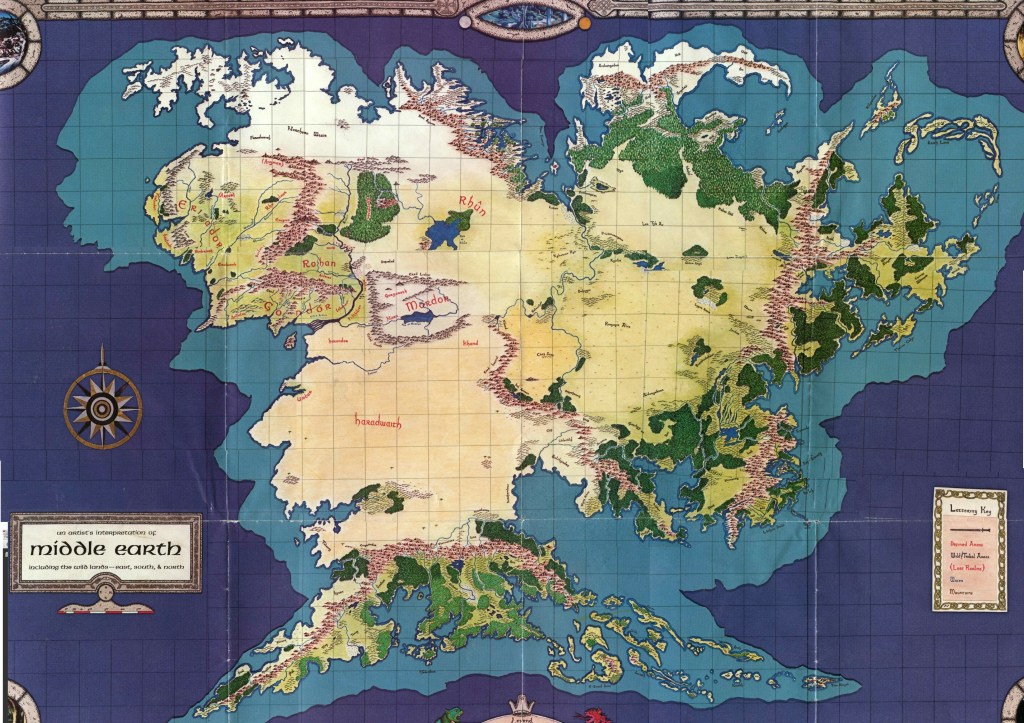
“I speak to maps. And sometimes they say something back to me. This is not as strange as it sounds, nor is it an unheard of thing. Before maps, the world was limitless. It was maps that gave it shape and made it seem like territory, like something that could be possessed, not just laid waste and plundered. Maps made places on the edges of the imagination seem graspable and placable.”
-Abdulrazak Gurnah
When it comes to fantasy novels, maps are a window into a whole new world. A world that only exists in the corners of your mind, a place outside of the boring world we live in that you can go to when nobody is around. The map within the front pages of a fantasy book is meant to show us that world in such a way that makes us feel like the adventurer, the ranger, the pirate. To see a mountain range dotted above hills and lakes and trees and wonder how long it might take to walk it, how cold it might be up on the peaks, how many magical creatures hide in those mountains; well this is part of the beauty of the fantasy book. From coastlines and ports to cities and castles, what makes a map of a place that only exists in the minds of imaginative readers and writers genuinely good?
I want to start by saying it has been about a year and 4 months since I started making fantasy maps, but I have been looking at them for far longer. As the father of fantasy, Tolkien’s middle earth map comes to mind as the original fantasy map; though I also love other iconic maps like C.S. Lewis’ Narnia and George R.R. Martin’s Westeros. As a young child I especially loved the map of the hundred acre wood in A. A. Milne’s Winnie the Pooh. This post will give advice on the process of creating maps, with reference to my experiences and my own maps; as well as details of what I believe a good fantasy map needs.
What makes a map good?
Before you make your map, it’s best to understand the fundamentals of what a good fantasy map actually is. This topic is debated and discussed by many, but I believe the necessities of a good fantasy map can be whittled down to very simple elements. So what will make my map good, you ask?
In advance of discussing my big point, I’d like to bring you back to high school English class, where we all learned about the elements of story. Plot, character, conflict, resolution, and setting. Your main goal when ideating a world should always be for your setting to be a character of its own. Your world should have traits and environments that directly affect the plot, and it should feel like a strong story element of its own. Think of your favourite fictional worlds and what makes them feel alive, and keep this in mind as you create. Now, for my main point.
The unknown is what will make your map intriguing. The unknown? But what does that even mean?
Think about when you were a child, when you began to learn about the things in our world that feel beyond our grasp. Perhaps you were shocked by the vast icy planes of the Arctic, or maybe you were intrigued by the great Egyptian pyramids. From the peak of Mount Everest to the ruins of Pompeii, our world is full of things that feel almost too magical to be real. These are the things that give our world some mystery and intrigue. These things are what I call the unknown.
Along with your cities and kingdoms and all the things we are familiar with, your world needs the unknown things as well; mysterious and strange things to make the reader wonder. A map is made good by the wonder and fantasy it creates in us, and the wonder lies in the contrast between a regular old port city and a secret cave full of magical stones.
(Examples of unknown things include but are not limited to: abandoned places, ruins, sunken things like wrecks or treasure, uncommon environmental phenomena, ancient artifacts, strange creatures, etc.)
How Do I Start?
When I began my map journey, I had no clue where to start. In all honesty, I really desperately wanted to make a map before I even wrote the first draft of my novel. So that’s what I did.
Think of an element that will make your map unique. Tolkien’s map has the dark and evil land of Mordor, Lewis’ map has the Ice palace in the wild land of the North, Martins map has the mysterious lands of Essos and Asshai across the sea. Pick something unique for your map (this isn’t an idea you have to be married to, because the beauty of maps is you can always make more.) Once you’ve chosen a unique element or two for your map, you can focus on some mysterious unknown elements. If you struggle to settle on an idea for what your maps unique trait and unknown elements will be, make a big brain dump list of all of the possibilities, then ask yourself what would intrigue you most as a reader; and build your world around that. Once you have a unique element or two, and some unknown places for your reader to fantasize about, the rest of your map and world will begin to flow into your mind like the water of a springtime stream.
Next, if you are not familiar with basic environmental information, I would look into some simple science behind things like tectonic plates, mountain ranges, bodies of water, forests, jungles, deserts, caves, etc. You do not need to be an environmental science expert, but knowing some basic info about these things will help you to create a world that is still believable even if it is magic. For example, a river attached to no other water is not believable; but a river attached to a lake or an ocean is believable. If your world is so magical and odd that you want none of our real world science to apply, that is also allowed. After all, it’s called fantasy for a reason.
Once you have decided on a unique element for your map and some mysterious unknown elements, and learnt a bit about different natural environments, you’re ready to make a map!
This is my first fantasy map, a map of the Island in my world that the story takes place on; called Lunadira.
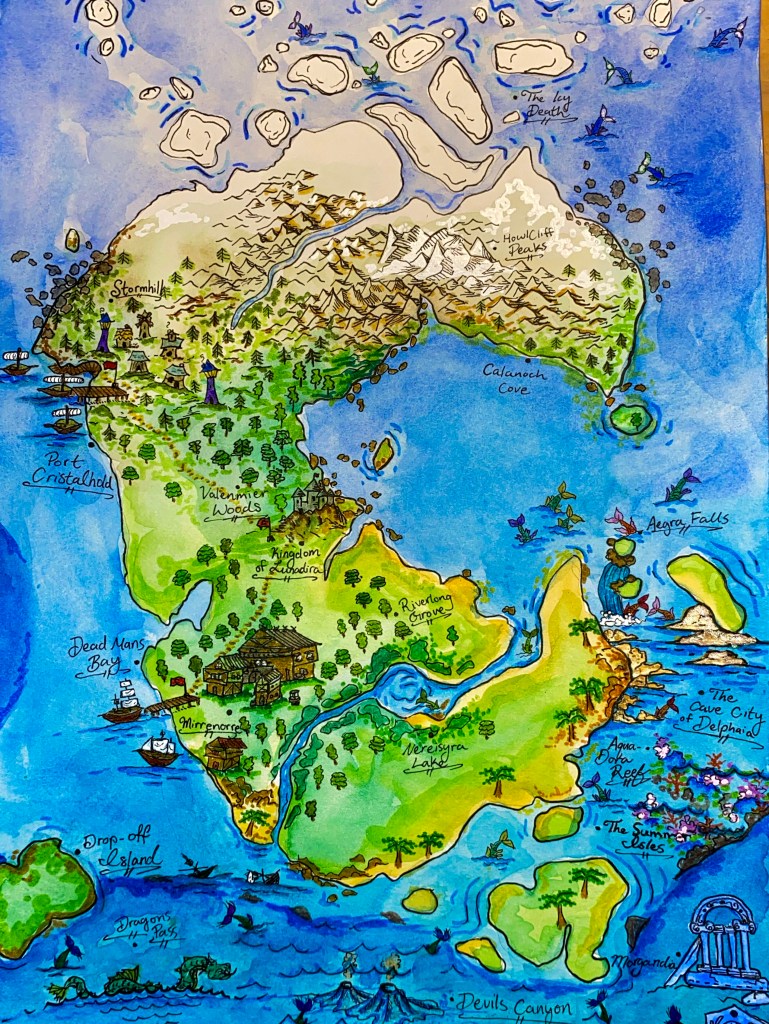
This is the first ever map of Lunadira. It’s a bit messy, but still has the elements of the world that are important to my story. The element I chose for my original map was that of a crescent moon shaped Island that embodies the extremes of summer and winter at either tip. For my unknown elements I have chosen an underwater city, some mermaids in the sea, some shipwrecks and ocean volcanoes. I chose to make this in watercolour and pen, but you can make a map in whatever medium feels good to you. If paper and drawing isn’t your thing, for digital maps I recommend https://inkarnate.com.
With this map in hand I was able to complete the first draft of my novel, as the visual aid helped me to identify with the people in my world; as well as do things like plot how long it takes to get from point A to point B.
I Made a Map. What’s Next?
Eventually, once you have created a draft of your map that includes its basic elements and environments, you can make a more detailed version.
This will help you get a better understanding of your setting, and learn its geography like the back of your hand. Though it may seem redundant to make a second map of the same place, it will help you write and understand your world better.
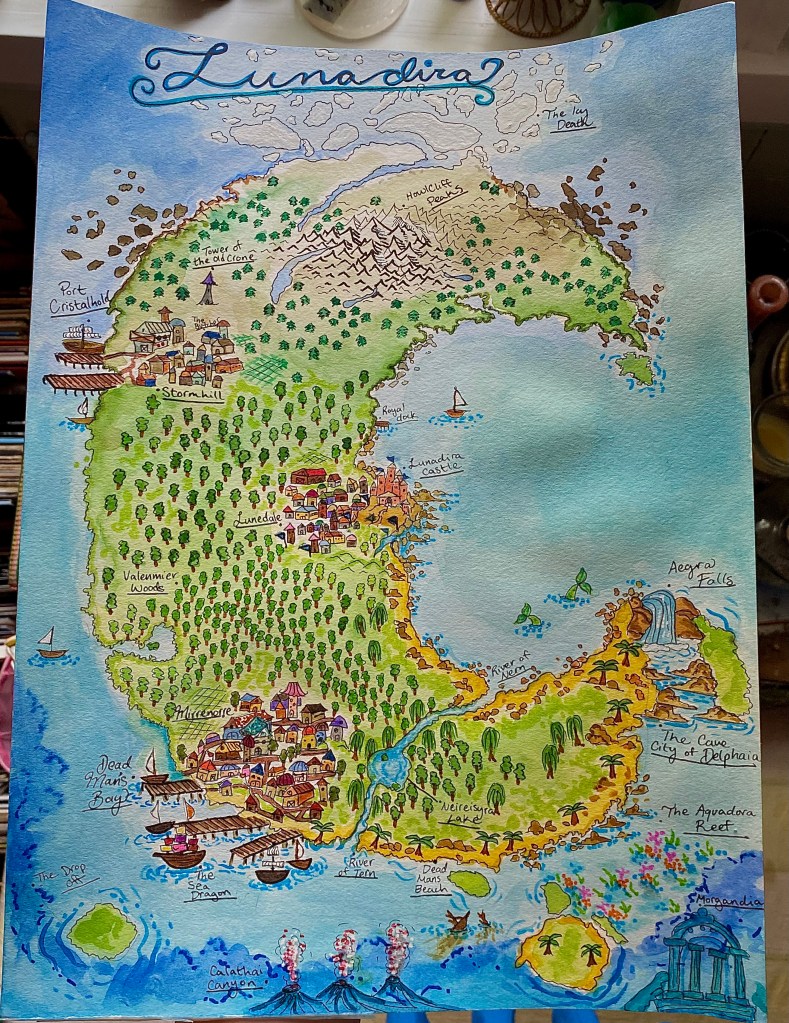
This Lunadira map looks different, and is more detailed than its predecessor. This was an exercise I did before beginning to edit my draft, to have access to something more specific and clean than my first map. Once again this is watercolour and pen, but I reccommend https://inkarnate.com for those who do not feel comfortable making illustrations.
What About the Rest of my World?
If you’ve created maps for the city or island or nation in your story, congratulations! But what about the rest of the world? If your original map includes the entirety of the world, you are a step ahead; but if not it’s time to make yet another map.
Think about what you want in the greater scope of your world. This step is full of opportunity, and anything you missed in the smaller maps can be squeezed into this big map. You may not even be writing any stories set in the other lands of your world yet; but trust me, to understand your world and better write your story, it helps to have an image of the greater scope of your world.
You can free draw it, you can make a meticulous list of all city names before even drawing a line; the process of your world map is up to you. After all, you’ll find after a small map or two, your brain is now a lot more primed to make a fantasy map.
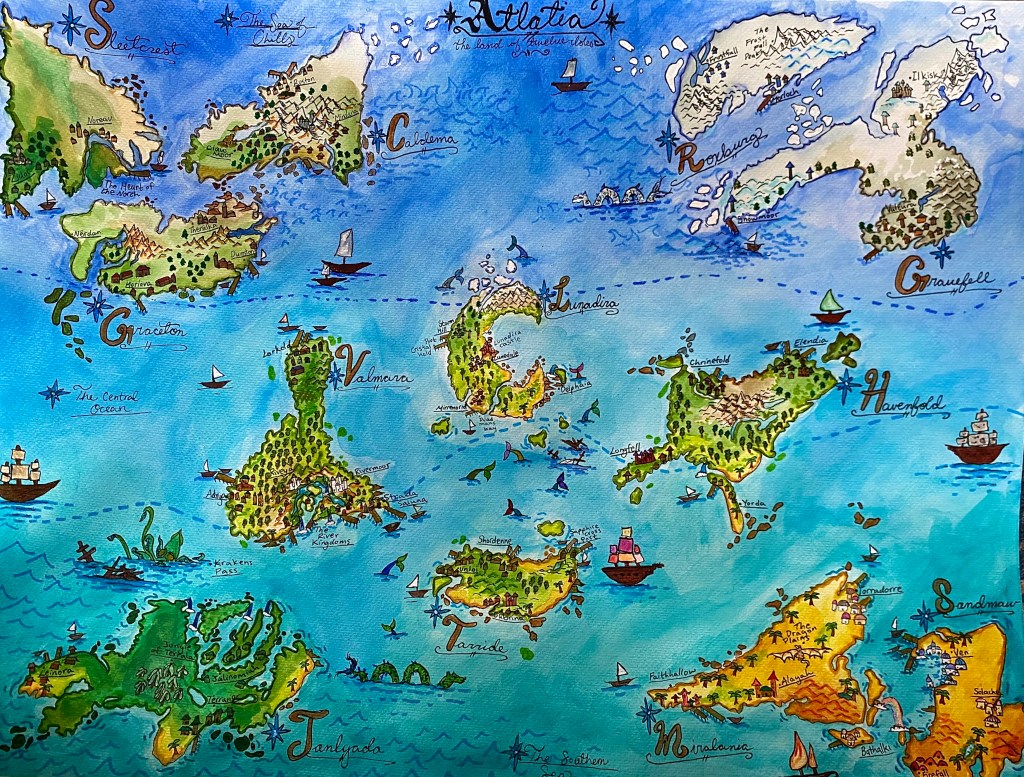
This is a watercolour map of my world, Atlatia; and in the middle you can see my little crescent moon shaped island, Lunadira. You can see in this map that the unknown is still present: a big kraken, some sea dragons, mysterious icy islands, pirate ships. The process of making a big world map gave me lots of good context for historical events that have taken place outside of my story.
The Benefits of Digital Maps
Personally, as an artist, I loved drawing my maps; and though the experience helped me create my world and feel like a part of the fabric of that universe, I want to briefly discuss the benefits of a digital map.
A digital map can be packed with detail that is nearly impossible to achieve with paper and pen, so why not use that to your advantage? If you have physical copies of your maps like I shared above, I would still recommend making a digital copy; simply because of how detailed and professional you can make them look. If you begin making your maps digital, you’ve already completed this step!
I cannot stress the life changing nature of https://inkarnate.com. It takes about an hour of fiddling with to learn how to use, and is quite user friendly. It is free for the first week of use, so squeeze all the maps you can get out of it in those seven days. If you become a real map nerd like myself, it’s definitely worth the price of the subscription.
With such detailed images, it can be so much easier to flesh out and edit your story. Images like these will help your creative mind flourish with ideas to fill your stories with magical adventures aplenty.
In comparison with my previous watercolour maps of Atlatia and Lunadira, these digital ones are cleaner, more detailed, and extremely cohesive and pleasing to the eye.
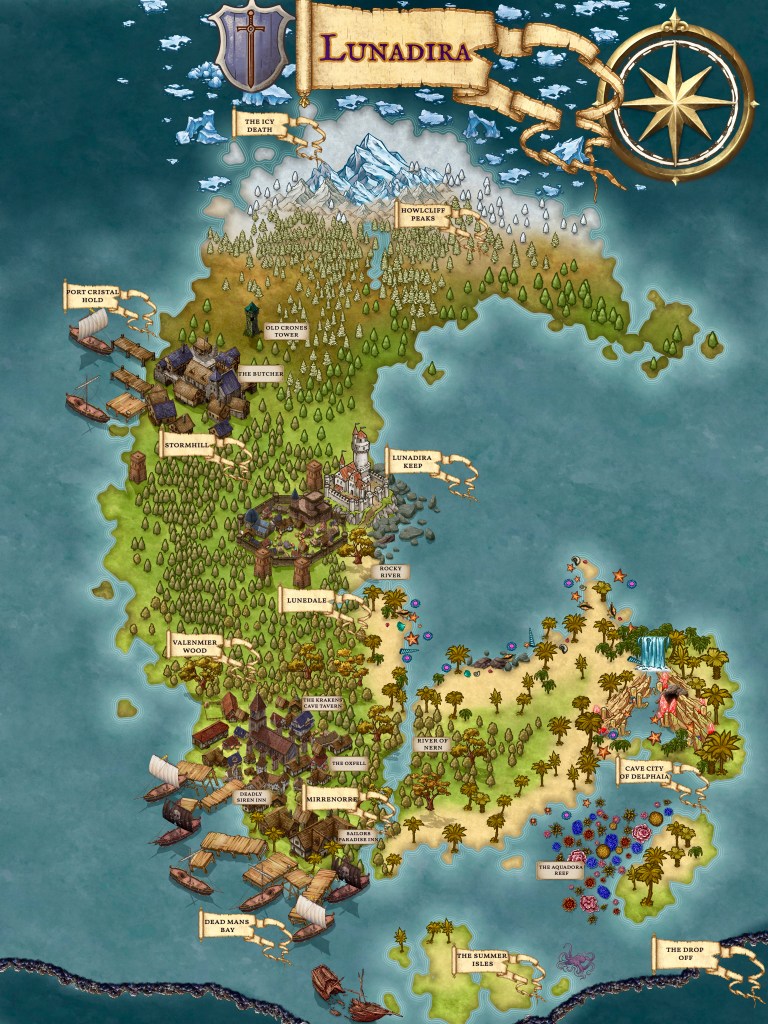
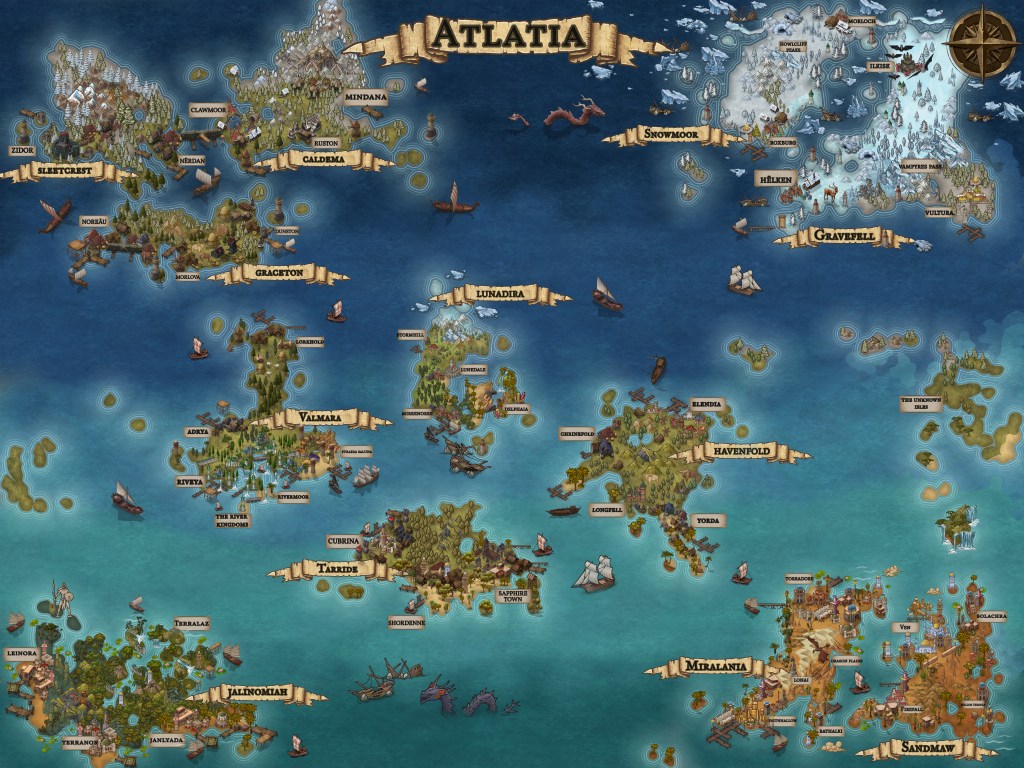
These maps were created on https://inkarnate.com.
Signing Off
I hope these ramblings gave insight into the wonderful world of fantasy maps, and inspired you whether you are a map making nerd or not. Perhaps it made you consider what is intriguing about the world we live in, or maybe it helped you remember a book you once read with a beautifully expansive world. Either way, I hope it made your mind wander to magical things.
˚ʚ♡ɞ˚ Happy reading, writing, and world building! ˚ʚ♡ɞ˚


Leave a comment